
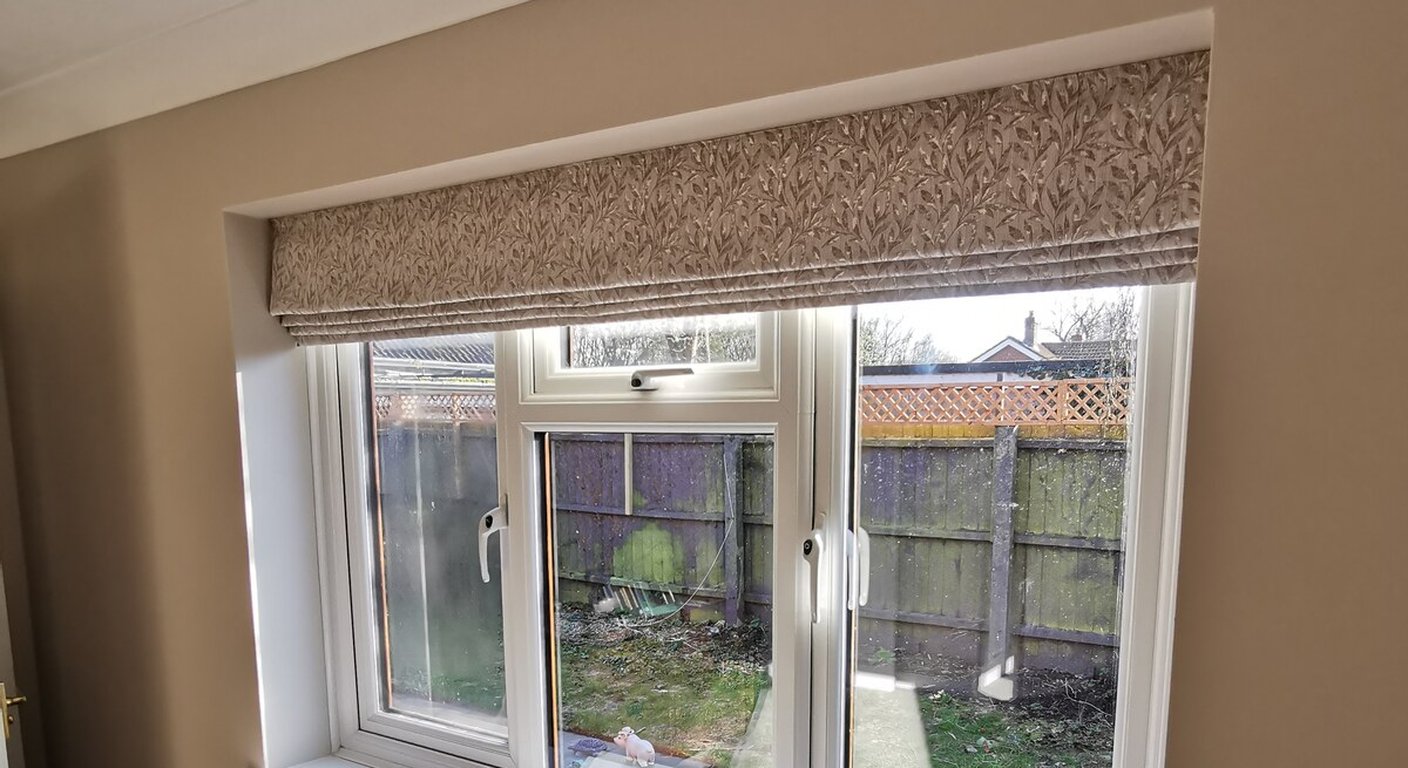
When the clocks go back, people start looking at their rooms
The clocks went back last weekend, and now it’s dark by half four. The heating’s on. The curtains, or the blinds, get closed earlier, and for the first time since March you’re actually sitting in the front room every evening and looking at it.
That’s usually when people ring us. Not about anything urgent. A room just feels a bit bare once the nights draw in, and they want it to feel warmer.
More often than not, that’s a Roman blind. Of everything we fit, I think it’s the one that looks warmest. It’s soft fabric at the window, and it gives you most of what curtains give you without filling the wall with them.
Quick Summary
- A Roman blind is a fabric blind that folds up into neat, flat pleats when you raise it
- You get the soft look of curtains without the bulk, which suits smaller rooms and windows with a radiator underneath
- The lining makes most of the difference: blackout for bedrooms, thermal or interlined for cold rooms and bays
- Living rooms, bedrooms, dining rooms and studies, yes. Bathrooms and over the kitchen sink, no
- A well-made Roman hangs straight and folds evenly. A badly made one never quite does
Why Romans feel like curtains, without being curtains
That’s really the whole point of a Roman, so I’ll say it plainly. You get proper fabric at the window, pattern and all, but it sits within the window (or just above it) instead of hanging floor to ceiling either side.
That matters more than people think. Plenty of homes round here have a radiator right under the window, and long curtains over a radiator send the heat straight up behind them and out through the glass. Some rooms are small enough that curtains take up half the wall. And some windows sit so close to a corner or a cupboard that there’s nowhere for curtains to stack back.
A Roman avoids all of that. When it’s down, you’ve got a flat panel of fabric. When it’s up, it folds away into a neat stack at the top of the window.
Some people have both: a Roman that does the work, and dress curtains either side that never get drawn. That works well in a big living room.
How a Roman blind actually works
You don’t need to know any of this to own one, but it helps when you’re choosing.
On the back of the blind there are thin rods sewn into pockets across the width, spaced evenly down its length. Cords run up through small rings on the back and into a headrail at the top, which is often called the cassette. When you raise the blind, the cords lift the bottom first, and the fabric folds up between the rods into pleats, each one stacking on the one above.
That’s why a Roman looks so tidy when it’s raised. The rods hold each fold straight, so the stack sits flat instead of bunching.
There are a couple of things worth knowing:
- A Roman takes up some of the window when it’s raised. The folds have to go somewhere. On a short window, the stack can take a fair bit of the glass. If daylight matters in that room, we’ll look at fitting the blind higher, above the window, so the stack sits mostly on the wall.
- You operate it with a chain or a cord. Either way it’s fitted with the child safety parts required by UK law, and that’s part of our job when we fit it. Motorised Romans are available too, which is handy on tall windows or a run of several.
The lining does most of the work
This is where I’d spend the most time if you were in the showroom. The fabric you see on the front is what you fall in love with. The lining behind it decides how the blind actually behaves.
Standard lining
Every decent Roman should be lined. A lining protects the face fabric from the sun, gives the blind some body so it hangs properly, and means the view from outside is a tidy plain back rather than the reverse of your pattern. For a dining room or a study, a standard lining is often all you need.
Blackout lining
For bedrooms, this is the usual choice. A blackout lining stops light coming through the fabric itself, so pattern and colour don’t matter, the room still goes dark.
Be realistic about the edges, though. A Roman fitted inside the window recess will always let a little light in round the sides, because the blind needs a small gap to move freely. If you want the room as dark as possible, fitting it outside the recess so it overlaps the window frame cuts that down a lot. That’s a conversation for when we see the window.
Thermal lining and interlining
A thermal lining is a thicker, insulating lining. Interlining goes one step further: it’s a soft, blanket-like layer sewn in between the face fabric and the lining.
An interlined Roman is a different thing to look at and to touch. It’s heavier, the folds are fuller and rounder, and it feels a lot like a good pair of lined curtains. In a room with a cold window, or a draughty bay, you do notice it on a winter evening. I won’t give you figures, because it depends far too much on the window, the room and how well it was fitted. But in an old house with single glazing or a bay that never feels warm, it’s the version I’d point you to.
Where Romans suit, and where they don’t
Romans are lovely, but they’re not right for every room, and I’d rather be honest with you about that up front.
Living rooms. This is where you see most of them. Warm fabric, a lamp on, the blind down at four o’clock. It’s what Romans are for.
Bedrooms. With a blackout lining, they’re a really good choice. Softer than a roller, and they make a bedroom feel finished.
Dining rooms and studies. Absolutely. A good place to try a bolder pattern, because you’re not in there all day.
Bay windows. Very good, as long as each pane gets its own blind, made to fit that pane. The joins are what you look at in a bay, so we take care over where each blind meets the next.
Kitchens. Not over the sink, and not near the hob. Fabric takes in steam and cooking smells, and splashes leave marks that don’t come out easily. A Roman on a kitchen window that’s away from the sink and cooker can be fine. Over the washing-up, I’d say a roller blind in a wipe-clean fabric every time.
Bathrooms. No. The folds hold moisture, the fabric stays damp, and mould follows. We wrote about this in more detail in our post on condensation and damp, but the short version is that a Roman in a steamy bathroom won’t last. Faux wood or a PVC roller will.
Very wide windows. There’s a limit to how wide one Roman can go before it gets heavy to lift and starts to droop in the middle. On a big window, we’ll usually split it into two or three blinds.
Pattern, and how it looks when the blind is half up
Here’s something people don’t always think about until the blind’s fitted. You’ll see a Roman half raised much more often than fully down, especially in the daytime. So what you’re really looking at most days is the folded stack, not the flat panel.
That changes how a pattern reads. A big floral can look striking flat and turn into a jumble once it’s folded. Stripes running across the blind can look smart flat and then look busy when the folds bunch them together. Small, all-over patterns, like the leaf print in the photo at the top of this page, tend to work well both ways. Plain fabrics with a bit of texture, a linen look or a soft wool weave, look right folded pretty much every time.
The other thing is the pattern match. On a patterned Roman, the design should line up neatly across each fold and be centred on the blind. It’s a small detail, but it’s the difference between a blind that looks made for the window and one that looks like it came off a roll.
If you’re not sure, we’ll bring samples out to you, and you can hold them up at your own window, in your own light. That tells you far more than a photo.
Why a badly made Roman never hangs right
I’ve been doing this for over 35 years and I’ve seen a lot of Romans, some ours, plenty not. When one looks wrong, it’s nearly always for one of a handful of reasons.
The most obvious is a blind that hangs crooked. If the rods aren’t sewn in parallel, or the fabric wasn’t cut square to the weave, the whole thing runs off at a slight angle. The bottom edge isn’t level with the sill, and once you’ve spotted it you can’t stop seeing it.
Then there’s the stack. The rods have to be spaced to suit the length of the blind, and when they aren’t you get folds that are fat at one end, or a last fold that hangs down further than the others.
Sometimes it’s the lining. If the lining and the face fabric weren’t made to sit together, one pulls against the other and you get puckering down the sides or a bottom edge that bows.
And sometimes the blind’s simply the wrong size. A Roman inside a recess has to fit that recess. Too wide and it catches on the sides, too narrow and there are strips of light down both edges. Recesses are rarely square, which is why we measure every one ourselves rather than working from someone else’s numbers.
So what should you look for? It should hang straight, fold evenly when you raise it, and go up and down without catching. On a patterned fabric, the pattern should be centred. We check all of that before we leave.
Our Romans come from trusted UK suppliers who make them to our measurements, and we measure and fit every one ourselves. The making is their job. Getting the size right and hanging it properly is ours, and that’s where a lot of Romans go wrong.
Looking after a Roman blind
They’re not hard work. Run the vacuum’s soft brush over the front and the folds every few weeks, and dab small marks with a damp cloth rather than soaking the fabric. Our care and cleaning guide has more.
Come and have a look
If a room’s been feeling a bit bare now the evenings are dark, have a look at our Roman blinds, or pop into the showroom on Eastern Way and feel the fabrics for yourself. The difference between a standard lining and an interlined one is something you really need to feel.
Or call us on 01284 761333 and we’ll come out to you with samples, measure up and give you a price. No hard sell, just honest advice.