
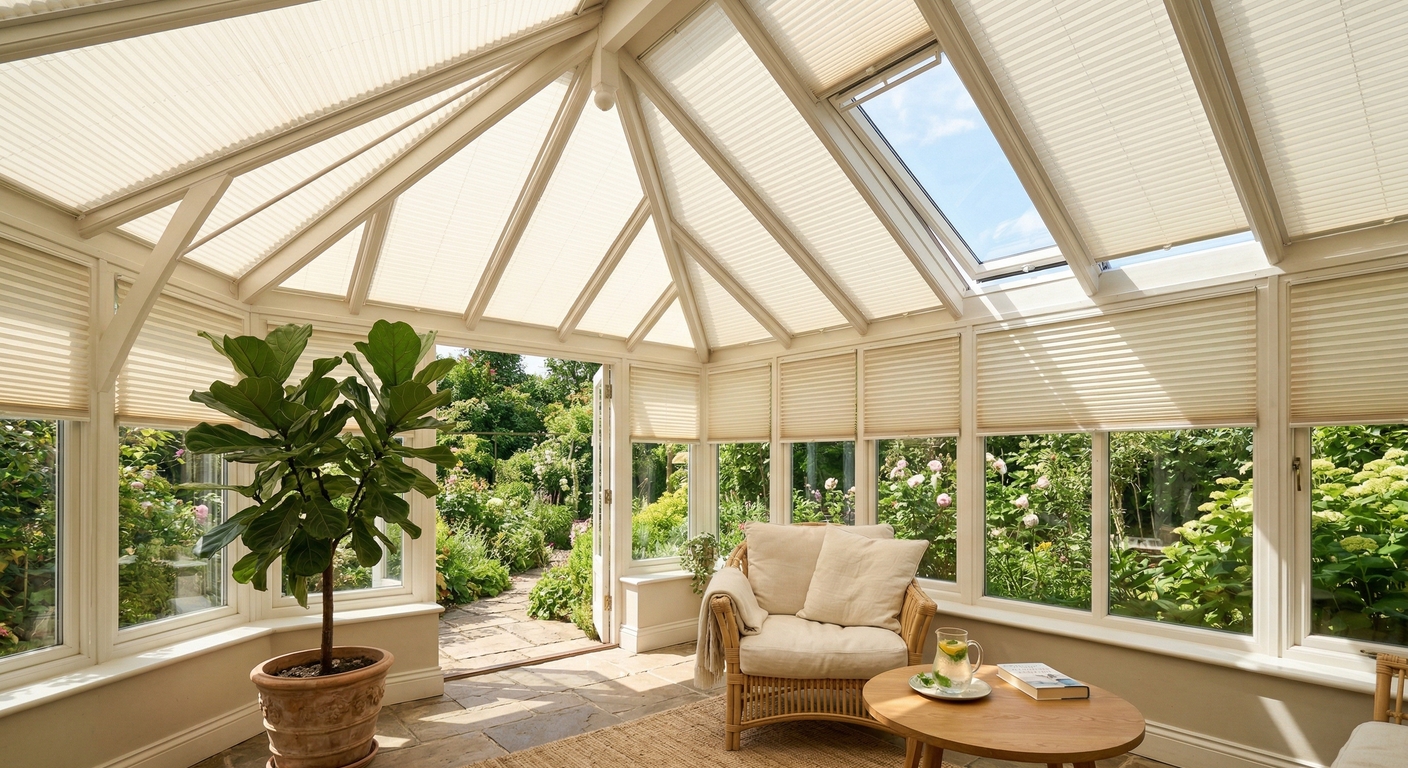
Your Conservatory Shouldn’t Be Unusable for Half the Year
We hear it all the time. “We love our conservatory, but from May to September it’s just too hot to sit in.” It’s one of the most common things people say when we visit homes across Suffolk and Norfolk. They’ve got this beautiful room, often the nicest space in the house, and it’s genuinely unbearable for the warmest months of the year.
The frustrating thing is that it doesn’t have to be that way. The right blinds, properly fitted, can make a real difference to the temperature and comfort in a conservatory. Not by blocking all the light, nobody wants to sit in a dark box, but by filtering the glare and reducing heat gain through the side windows. We’ve fitted hundreds of conservatories over the years, and the difference the right blinds make is noticeable straight away.
Quick Summary
- Conservatories overheat because glass lets heat in but traps it, blinds help break that cycle
- Side blinds with reflective or solar-control fabrics make a genuine difference to comfort
- Pleated, roller, vertical, and Perfect Fit blinds are all good options depending on the window type
- Honeycomb blinds can reduce heat loss by up to 33%. They work in winter too
- Every conservatory is different, orientation, window type, and how you use the space all matter
Why Conservatories Overheat
It’s worth understanding the problem before talking about solutions. A conservatory is essentially a glass box. Sunlight passes through the glass, heats up the surfaces inside, the floor, the furniture, the walls, and those surfaces radiate heat back into the room. But the glass that let the sunlight in won’t let the heat back out easily. So it builds up. And builds up. And by midday on a sunny day in July, you’ve got a room that’s fifteen degrees hotter than the rest of the house.
Orientation matters as well. A south-facing conservatory gets the full force of the midday sun. East-facing rooms heat up in the morning. West-facing ones get the afternoon and evening sun. North-facing conservatories rarely have a serious heat problem. It’s good to take orientation into account when choosing fabrics and blind types.
The Best Blinds for Conservatory Windows
Pleated Blinds
Pleated blinds are one of the most popular choices for conservatory side windows. They’re lightweight, compact, and available in a huge range of fabrics, from sheer to blackout, plain to patterned. The pleated fabric folds into a neat stack when the blind is open, taking up very little space at the top of the window.
For conservatories, we’d usually recommend a fabric with a reflective backing. These fabrics bounce the sun’s heat back through the glass before it enters the room. From inside, you still get a pleasant, diffused light, but the temperature difference is noticeable.
Pleated blinds are available as standalone units or in the Perfect Fit system, which clips into the window frame without drilling. Either way, they look smart and work brilliantly in conservatories.
Honeycomb Blinds
If pleated blinds are good, honeycomb blinds are exceptional. Honeycomb blinds have a clever double-layered construction that traps air in honeycomb-shaped cells. That trapped air acts as insulation, and it works both ways: it keeps heat out in summer and keeps warmth in during winter.
The numbers are genuinely impressive. Honeycomb blinds can reduce heat loss through a window by up to 33%. In a conservatory, where much of the structure is glass, that makes a noticeable difference to both comfort and energy bills.
They’re more expensive than standard pleated blinds, but for a conservatory that you want to use all year round, they’re worth the investment. We’ve had customers tell us their conservatory went from being a three-season room to a genuine year-round living space after we fitted them.
Perfect Fit Blinds
For conservatories with UPVC windows and doors, which is most of them, Perfect Fit blinds are hard to beat. They clip directly into the window frame with no drilling, no screws, and no cords hanging down. They move with the door when you open it, which is particularly handy for French doors and tilt-and-turn windows.
Perfect Fit blinds are available in pleated, roller, and venetian styles. For conservatories, we usually recommend pleated Perfect Fit because they give you that heat-reflective performance if you choose the right fabric, and the clip-in frame looks clean and unobtrusive.
The big advantage in a conservatory is that every panel gets its own blind, each one independently controlled. You can have the south-facing windows filtered while the shaded side stays open. That flexibility makes a real difference on days when the sun moves around the room.
Roller Blinds
Roller blinds are a straightforward option for conservatory side panels. They’re available in a wide range of fabrics, including solar reflective and moisture-resistant options, and they pull up neatly out of the way when you don’t need them.
For conservatories, we often suggest a fabric with a solar-reflective backing to help manage the heat. The choice of roller blind fabrics is enormous, so there’s plenty of scope to match your existing decor.
Vertical Blinds
Vertical blinds work particularly well on wide conservatory windows and patio doors. The louvres can be angled to redirect sunlight rather than block it completely, which gives you useful control over glare without darkening the room.
They’re also practical for doors that you open regularly. The louvres part easily and fall back into place. In a conservatory where you’re constantly going in and out to the garden, that matters.
Choosing the Right Fabric
Not all conservatory blind fabrics are equal. Here’s what to look for:
Reflective backing: The single most important feature for heat control. A fabric with a silver or white reflective backing bounces heat back through the glass. It makes a bigger difference than the fabric colour or thickness.
Light filtering vs blackout: Most people want light filtering in a conservatory. The point is to keep the room bright and airy while reducing heat. Blackout fabrics make sense where glare is a serious problem, but they’re the exception.
Colour: Lighter colours reflect more heat than darker ones. A white or cream fabric with a reflective backing will perform best. But darker fabrics with a good reflective backing still work well. The backing does most of the work.
Moisture resistance: Conservatories can get humid, especially with lots of plants. Choose fabrics that handle moisture well. Most modern conservatory blind fabrics are designed for this, but it’s worth checking.
What About Motorisation?
Motorisation is worth considering if you’ve got a lot of conservatory windows to manage. Rather than walking around adjusting each blind individually, motorised blinds let you control everything from a remote or your phone.
You can even set them to adjust automatically based on the time of day. Leave for work in the morning with the blinds open, and they’ll close themselves when the sun comes round. Come home to a comfortable conservatory instead of a greenhouse.
What About the Cost?
Fitting out a full conservatory with quality blinds isn’t cheap. A typical conservatory with four or five side panels might have six to ten individual blind panels depending on the window layout. Each one is made to measure.
But consider what you’re getting: a room that was uncomfortable for four or five months of the year becomes usable year-round. If you factor in the energy savings from better insulation in winter, especially with honeycomb blinds, the investment starts to make more sense.
It’s always an option to do a conservatory in stages if budget is a concern. Start with the windows that get the most sun and add the rest later. That way you get the most impact straight away without stretching yourself.
Frequently Asked Questions
Will conservatory blinds really make a difference?
Yes. Side blinds with reflective fabrics make a noticeable difference to the temperature and glare in a conservatory. Customers consistently tell us it’s one of the best home improvements they’ve made, especially those who’d basically written off their conservatory during the summer months.
What types of blind work best in a conservatory?
It depends on the window type and what you’re after. Perfect Fit blinds are ideal for UPVC windows and doors. Vertical blinds work well on wide panels and patio doors. Pleated and honeycomb blinds offer the best insulation. We’ll recommend the right combination during a free home survey.
Do conservatory blinds help in winter too?
This is the bit people don’t always expect. Good conservatory blinds, especially honeycomb (Duette) types, insulate the room in winter as well as cooling it in summer. The trapped air in the honeycomb cells works both ways. Several of our customers have told us their conservatory heating bills dropped noticeably after fitting.
How long does it take to fit a full conservatory?
Typically half a day to a full day, depending on the number of panels and whether you’re going motorised. We do everything in one visit, measure, make up, and fit are separate stages, but the fitting itself is usually done within the day.
Can I just do a few windows to start with?
Absolutely. We’d suggest starting with the windows that catch the most sun: usually the south or west-facing side. You’ll notice the biggest improvement there, and you can add the rest later when the budget allows.
Let’s Sort Your Conservatory Out
If your conservatory is sitting there unused because it’s too hot, let’s fix that. We’ll come out, take a look at the windows, check the orientation, and give you an honest recommendation. We bring fabric samples so you can see exactly what’ll work in your space. No obligation, no pressure, just practical advice from people who’ve done this hundreds of times. Get in touch and we’ll arrange a visit.