
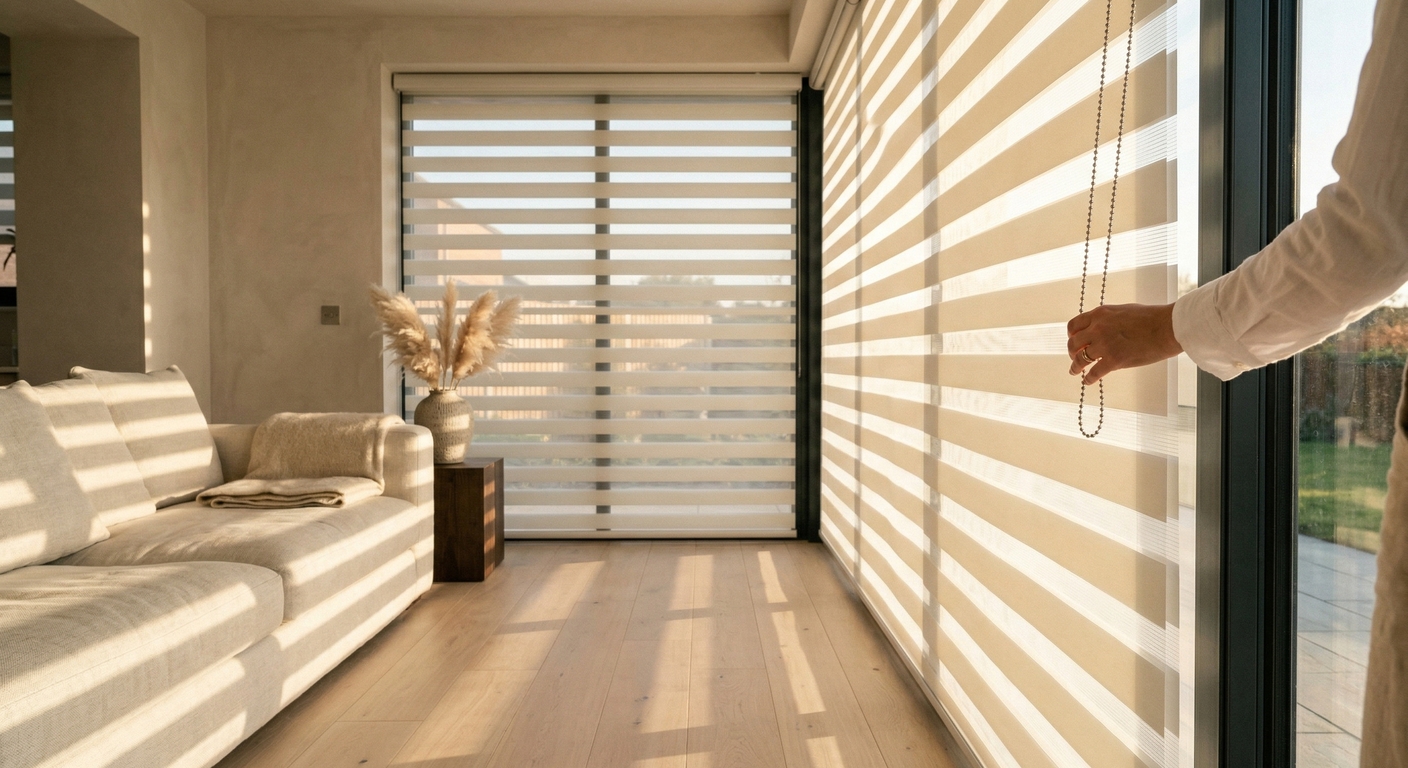
The Blind That Makes People Say “I Didn’t Know That Existed”
If there’s one product that consistently surprises people on a home visit, it’s the vision blind. We’ll pull a sample out, show them how it works, and almost every time the reaction is the same. A raised eyebrow and “oh, that’s clever.” It’s become one of the most popular blinds we fit, and honestly, it’s not hard to see why.
Vision blinds, sometimes called day and night blinds or zebra blinds, give you something no other single blind can: full privacy, filtered light, and an open view, all from the same blind. No swapping between curtains and blinds, no compromising. Just one product that adapts to whatever you need at that moment.
Quick Summary
- Vision blinds use alternating sheer and solid fabric stripes that slide past each other
- Align the stripes for filtered light and an open feel, offset them for full privacy
- They suit living rooms, bedrooms, and kitchens, anywhere you want flexible light control
- Clean, modern look that works with contemporary and traditional interiors alike
How Vision Blinds Actually Work
The mechanism is beautifully simple. A vision blind is made from a single continuous loop of fabric with alternating stripes, one sheer, one solid. The fabric wraps around a roller at the top and a weighted bar at the bottom, creating two layers that sit in front of each other.
When you adjust the blind using the chain or cord, the two layers shift relative to each other. Line up the sheer stripes and you get soft, filtered light coming through. You can see out, but passers-by can’t easily see in. Offset the stripes so the solid sections overlap, and you get full privacy with no light gaps between the bands.
It’s that transition between open and closed that people love. There’s no sudden switch from “light” to “dark” like you get with a roller blind. Instead, you can fine-tune exactly how much light and privacy you want. It’s a bit like having a venetian blind’s adjustability with a roller blind’s clean lines.
Why They’re Rivalling Roller Blinds on Home Visits
Five years ago, most people who booked a home visit were thinking roller blinds. Simple, affordable, does the job. And roller blinds are still brilliant. We fit hundreds every year. But vision blinds have quietly become the product that steals the show.
Here’s what we hear from customers:
“I wanted privacy without losing the light.” This is the big one. Roller blinds are either up or down. Net curtains look dated. Vision blinds sit right in that sweet spot. You get daytime privacy without feeling like you’re sitting in a cave.
“They look more expensive than they are.” Vision blinds have a real wow factor. The fabric movement, the way the light plays through the sheer stripes. It looks like something from a high-end interior design magazine. But they’re priced much closer to a standard roller blind than people expect.
“I didn’t realise one blind could do all that.” The versatility is genuinely impressive. Morning coffee with soft filtered light. Afternoon film with the room dimmed. Evening privacy without drawing curtains. One blind, three completely different looks.
Which Rooms Suit Vision Blinds Best?
Living Rooms
This is where vision blinds really shine. Living rooms need flexible light control, bright and airy during the day, cosy and private in the evening. A vision blind handles both without you having to think about it. They look particularly good on larger windows where the stripe pattern has room to breathe.
Bedrooms
Vision blinds work well in bedrooms, though with a caveat. The sheer stripes do let some light through even when the solid stripes are fully overlapped. If you need complete blackout, for shift workers or young children, a dedicated blackout roller blind is still the better choice. But for most bedrooms where you want a balance of morning light and nighttime privacy, vision blinds are ideal.
Kitchens
The fabric on some vision blinds is easy to wipe clean, which makes them practical for kitchens. They’re a real upgrade from the standard kitchen roller blind because you can keep that filtered light coming in while you’re cooking without feeling exposed to the neighbours. We’d recommend sticking to lighter colours in kitchens. They show grease marks less than you’d expect, and they keep the room feeling bright.
Bathrooms
Vision blinds can work in bathrooms, but we’d suggest checking the fabric is moisture-resistant before committing. Some vision blind fabrics handle humidity better than others. For a bathroom with good ventilation, they’re a stylish option. For a particularly steamy bathroom, a waterproof roller might still be the safer bet.
Home Offices
With more people working from home, we’re fitting a lot of vision blinds in home offices. They solve the glare-on-screen problem without you having to sit in the dark, just shift the stripes to filter the light, and you can still see your garden while you work.
Vision Blinds vs Roller Blinds vs Venetians
People often ask how vision blinds compare to what they’ve already got. Here’s the honest breakdown:
Light control: Vision blinds give you more nuance than a roller blind (which is either up or down) but less precise control than a venetian (which lets you angle individual slats). In practice, most people find vision blinds hit the right balance, enough control without the fuss.
Privacy: Vision blinds offer excellent daytime privacy with the sheer stripes aligned. Roller blinds only give you privacy when they’re fully down. Venetians give good privacy but the slats can still be peeked through at certain angles.
Looks: This is subjective, but vision blinds tend to look more contemporary than venetians and more interesting than plain rollers. The stripe pattern adds texture and movement to a window without being busy.
Maintenance: Vision blinds are about as easy to maintain as roller blinds. A wipe with a dry or damp cloth is usually enough. Venetians need more attention because dust settles on each individual slat.
Cost: Vision blinds sit between roller blinds and wooden venetians in terms of price. They’re not the cheapest option, but they’re not the most expensive either, and for what you get, they’re excellent value.
Fabric Options and Colours
The range of vision blind fabrics has grown massively over the past few years. When they first came out, you were limited to a handful of neutral colours. Now there are dozens, from crisp whites and soft greys through to bold charcoals, warm taupes, and even textured weaves.
Most of our customers go for neutral tones. Whites and light greys are the most popular because they let the most light through the sheer stripes and suit almost any room. But we’ve had some lovely results with darker fabrics in bedrooms and feature windows. A charcoal vision blind in a modern bedroom looks stunning.
The fabric weight and texture affect how the blind hangs and how the light filters through. Heavier weaves tend to give better privacy; lighter fabrics let more light in. We always bring a good selection of samples on a home visit so you can see exactly how each fabric looks against your windows and walls.
A Word on Fitting
Vision blinds can be fitted inside the window recess or face-fixed above it, just like roller blinds. Recess fitting gives a neater look. The blind sits flush inside the frame. Face fitting is better if your recess is shallow or you want the blind to cover a larger area.
One thing worth knowing: because vision blinds have two layers of fabric sitting side-by-side, they need slightly more depth than a standard roller blind. If your window recess is very shallow, we’ll check the measurements and let you know what works best. It’s one of those things that’s much easier to get right with a professional measure, guessing the depth is where DIY orders tend to go wrong.
The Pelmet: A Neat Finishing Touch
Every vision blind we fit comes housed in a 70mm metal pelmet that sits across the top of the window. It’s not just there for looks. It hides the roller mechanism completely, so all you see is a clean, flat fascia.
What makes it look particularly smart is the matching fabric insert. A strip of the same vision blind fabric you’ve chosen is fitted along the front of the pelmet, so it blends seamlessly with the blind below. It’s a small detail, but it makes a real difference to the finished look, especially on face-fixed blinds where the pelmet is more visible.
The pelmet is available in white or anthracite. Most people go with white to match their window frames, but the anthracite finish works beautifully in modern interiors with darker window frames or feature windows. We’ll bring both options on a home visit so you can see which suits your room.
Frequently Asked Questions
Are vision blinds good for privacy?
Very good. When the solid stripes overlap, they give you full privacy, nobody can see in from outside. When the sheer stripes are aligned, you get soft daytime privacy, you can see out but it’s much harder for anyone to see in, especially if the room behind is darker than the light outside.
Do vision blinds block out light completely?
Not completely. Even with the solid stripes fully overlapped, a small amount of light can come through where the stripes meet. For most rooms this is more than enough. The room will feel dim and private. But if you need total darkness for sleeping, a blackout roller blind is still the better option.
Can I get vision blinds motorised?
Yes. Motorised vision blinds work brilliantly. You can adjust the light level from a remote, a wall switch, or your phone. They’re particularly good for large windows or hard-to-reach spots. We fit motorised vision blinds across Suffolk and Norfolk, and the feedback is always excellent.
How do I clean vision blinds?
A dry or slightly damp microfibre cloth is all you need for day-to-day care. Wipe gently along the stripes rather than across them. Avoid soaking the fabric or using harsh cleaning products. The same advice we’d give for roller blinds.
How long do vision blinds last?
With proper care, you can expect eight to twelve years from a quality vision blind. The mechanism is reliable and the fabrics are designed to resist fading. As with any blind, kitchen and bathroom environments will shorten the lifespan slightly compared to a bedroom or living room.
See Them for Yourself
Vision blinds are one of those products that’s genuinely better in person than in photos. The way the fabric moves, the shift between sheer and solid. You need to see it to really get it.
We bring a full range of vision blind samples on every home visit. There’s no obligation, no pressure, just a chance to see the fabrics, try the mechanism, and get an honest opinion on whether they’re right for your windows. Get in touch and we’ll arrange a time that suits you.